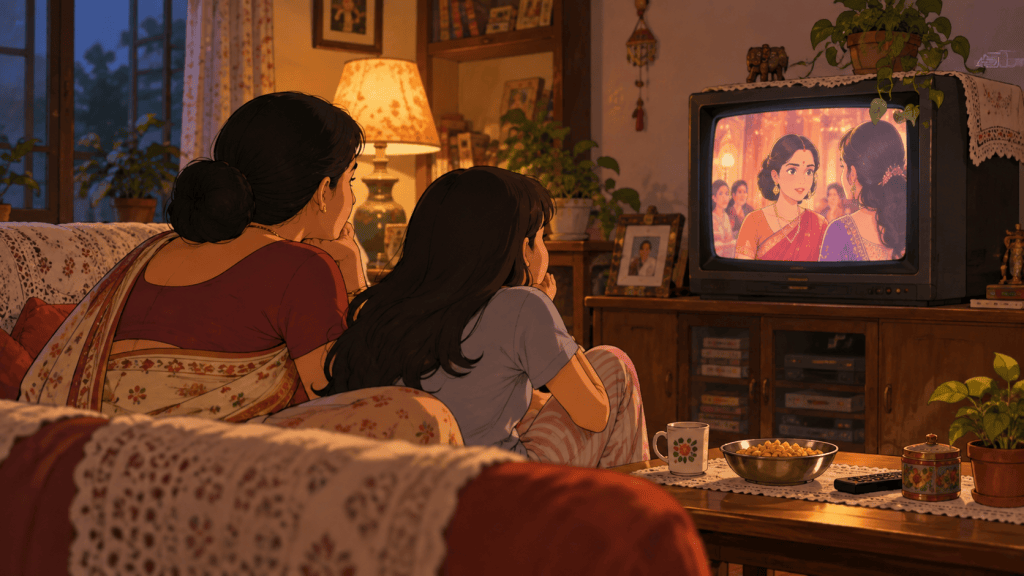
The Stories That Taught Us How to Be Women
From Tulsi to Instagram, how changing media changed the way Indian women see themselves
Today, a friend of mine in the US asked me a rather funny question.
“How do you know what Costco is? You’ve never even been to America.”
I laughed.
Of course I knew what Costco was.
I’d seen it on American television shows. I’d seen it on social media. I’d watched Americans casually talk about shopping there, seen the giant carts, the enormous stores and the jokes about going in for three things and coming out with enough supplies to survive an apocalypse.
I’d never stepped inside a Costco.
But I knew it existed.
And that tiny conversation stayed with me.
Because it made me realise just how much of the world we know without ever having experienced it ourselves.
I know what an American suburban house looks like without having lived in one. I know what a Korean convenience store looks like without having been to Korea. I know what an American high-school prom looks like despite never having attended one.
The world has been entering our homes through screens for decades.
But the women who came before us didn’t grow up with that kind of access.
And perhaps that is one of the biggest differences between the Indian women who raised us and the women our generation is becoming.
Our mothers had fewer stories to choose from
This isn’t about saying that older Indian women were less educated, less intelligent or less curious.
It is about access.
For many Indian women who grew up in the decades before satellite television, the internet and social media, the sources from which they could learn about the world were naturally more limited.
Family.
Neighbours.
School.
Books, if they had access to them.
Magazines.
Films.
Radio.
And eventually television.
The women physically around them were therefore enormously important reference points for what a woman’s life was supposed to look like.
If every woman you knew married, had children, managed a household and adjusted to her family, those things could begin to feel less like one possible way of living and more like the natural order of things.
Not because anyone was stupid.
Because human beings understand the world partly through the examples available to them.
And then television exploded.
Enter Tulsi
If you grew up in India in the 1990s and 2000s, there is a good chance you knew Tulsi.
Or Parvati.
Or Prerna.
Or one of the hundreds of women who appeared in the seemingly endless parade of Indian television serials.
Indian television had been carrying gender stereotypes long before the saas-bahu era. Research examining Indian television programming found recurring portrayals of women as homemakers and reinforced traditional gender roles across different periods of television.
But the daily soap took something to another level.
The woman who sacrificed.
The woman who adjusted.
The woman who kept the family together.
The ideal wife.
The ideal mother.
The ideal daughter-in-law.
The woman whose greatest victory was often restoring her family.
And, conveniently, another woman was usually standing on the other side of the battlefield.
The vamp.
The scheming saas.
The jealous sister-in-law.
The other woman.
Women fighting women became entertainment.
And perhaps the most interesting part is that women were often the ones consuming these stories day after day.
But I don’t think it is fair to look back and say, “How could women have watched this nonsense?”
They weren’t sitting there thinking, Excellent, I shall now absorb patriarchal values.
They were watching television.
They were relaxing after work.
They were cooking while listening to the episode.
They were discussing the characters with their sisters, mothers, neighbours and friends.
It was entertainment.
But when a particular version of womanhood appears on television for thousands of hours, something interesting happens.
The extraordinary can begin to look ordinary.
We didn’t necessarily learn the lesson. We learned that this was a possible script.
This distinction matters.
I don’t think television automatically made Indian women submissive.
Reality is far too complicated for that.
Indian television itself was also reflecting ideas that already existed in Indian society.
But it repeatedly gave those ideas characters, plots and emotional rewards.
A woman sacrificed, and the sacrifice was presented as noble.
A woman endured, and her endurance became her strength.
A woman put her family before herself, and that was treated as virtue.
Meanwhile, the woman who wanted something for herself could be portrayed as selfish, arrogant or “too modern.”
And after watching enough of it, perhaps we didn’t consciously believe it.
But we became familiar with the script.
And sometimes familiarity is powerful.
Then millennials grew up
And our media diet became completely ridiculous.
We had Indian serials.
Bollywood.
Cartoons.
Friends.
Harry Potter.
American sitcoms.
Books.
Magazines.
Orkut.
Facebook.
YouTube.
Netflix.
Instagram.
K-dramas.
Podcasts.
Suddenly, the Indian woman was no longer the only woman we could observe.
We could see women living alone.
Women travelling alone.
Women choosing not to marry.
Women divorcing.
Women building companies.
Women talking openly about sex, money, motherhood, mental health and careers.
Women who didn’t want children.
Women who wanted five children.
Women who lived with their parents.
Women who moved across the world.
Women who cooked because they enjoyed it.
Women who couldn’t boil water and didn’t particularly care.
And somewhere in all that noise, a rather dangerous thought entered the minds of many women:
“Wait. It doesn’t have to be this way.”
Not “my way is better.”
Just:
“There are other ways.”
And that is a profound difference.
Maybe exposure doesn’t tell us what to want. Maybe it gives us something to compare with.
This is where I think the real transformation happened.
Seeing another woman’s life doesn’t automatically make us want her life.
You might see a woman living alone and think, “That’s amazing.”
Someone else might think, “I’d be miserable.”
Both have been exposed to the same possibility.
So perhaps content doesn’t simply teach women what to want.
Perhaps it gives us more things against which to compare the lives we’ve been given.
And comparison can be liberating.
A woman can begin to ask:
Why is this expected of me?
Why does marriage have to mean this?
Why does motherhood have to mean that?
Why am I responsible for everyone’s emotional wellbeing?
Why is domestic work automatically mine?
Why does being a good woman require so much sacrifice?
And perhaps the biggest question:
Who decided that this was what a woman was supposed to be?
From Tulsi to Instagram
Then came social media.
And here, I think we need to be careful.
It is very tempting to tell a neat story:
Television taught Indian women patriarchy. Instagram taught them feminism.
I don’t think that is true.
Instagram doesn’t show us the world.
It shows us a version of the world filtered through our interests, behaviour and the algorithm.
If I keep watching feminist content, Instagram will show me more feminism.
If I keep watching traditional homemaking content, I’ll get more of that.
If I watch career content, I’ll get career content.
If I watch beauty videos for three days straight, apparently Instagram has decided that my life’s purpose is to buy seventeen different serums.
The algorithm doesn’t necessarily broaden our worldview.
Sometimes it does the opposite.
It can build a very comfortable little room around what we already believe.
Two women can open Instagram on the same day and live in completely different realities.
One sees women demanding independence.
Another sees women celebrating traditional domestic roles.
Both can come away thinking:
“Everyone seems to agree with me.”
They don’t.
The algorithm simply knows what keeps us looking.
And yet, despite that limitation, social media has done something extraordinary:
It has made exposure possible at a scale previous generations could never have imagined.
Geography doesn’t determine what a woman can think
This is where someone like Pujarini Pradhan, better known as Life of Pujaa, becomes interesting.
She comes from a small village in West Bengal, yet has built a large online audience around commentary on books, films, feminism, religion, capitalism and everyday life.
And I find that fascinating.
Because we often make assumptions about exposure based on geography.
City = progressive.
Village = conservative.
Educated = progressive.
Traditional family = conservative.
But the internet has complicated all of that.
A woman doesn’t necessarily have to leave her village to encounter a different world anymore.
She can read a book.
Watch a film.
Listen to a podcast.
Follow someone thousands of kilometres away.
Find a community.
Learn something.
Question something.
And then create something herself.
The phone has made geography a much weaker predictor of exposure than it used to be.
And then there is Afghanistan
This is where the question becomes much bigger than Indian television.
Afghanistan under Taliban rule offers a painful example of what happens when access to education, information and public participation is severely restricted.
Since the Taliban returned to power in 2021, girls have been barred from secondary and higher education, and women have faced increasingly severe restrictions on work and public life. UNESCO describes Afghanistan as the only country where girls and women are currently prohibited from secondary and higher education.
And restrictions extend into media and information.
Women journalists have been pushed out of the profession in huge numbers, while women and girls face restrictions on the media they can access and consume. At the same time, alternative media initiatives have continued broadcasting educational programming to women and girls who have been shut out of formal education.
That raises a question I don’t think has a simple answer:
Do we need to see another way of living before we can imagine wanting it?
Perhaps not.
A person can feel the weight of restriction without having a detailed blueprint for an alternative.
But exposure can do something important.
It can turn an abstract possibility into a visible one.
You don’t just hear that another life exists.
You see it.
And once you know that something is possible, you can compare it with your own circumstances.
That doesn’t mean content automatically creates a desire for freedom.
It means access to information expands the catalogue of lives a person knows are possible.
And perhaps that is why controlling education and information is so powerful.
You aren’t only controlling what people do.
You are also limiting some of the things they can easily see, compare and imagine.
Maybe this is what changed for Indian women
Our mothers didn’t necessarily lack ambition.
They didn’t necessarily lack intelligence.
They didn’t necessarily lack the desire for freedom.
They simply grew up in a media environment where fewer alternative versions of women’s lives were constantly visible.
Our generation grew up in the middle of an explosion of alternatives.
And now we are trying to figure out what to do with them.
We are simultaneously carrying what our mothers taught us and questioning it.
We want careers and families.
Independence and belonging.
Tradition and choice.
We want to be good daughters without disappearing into our families.
We want to be good mothers without losing our identities.
We want relationships without believing that relationships should consume our entire identities.
We want to care for people without believing that caring for everyone is automatically our responsibility.
And sometimes we’re terrible at balancing all of it.
Because we’re the generation that is trying to unlearn while still living inside the old rules.
And perhaps we owe our mothers some grace
It is very easy for our generation to look backwards and think:
Why didn’t she leave?
Why didn’t she say no?
Why did she tolerate that?
Why didn’t she have a career?
Why did she care so much about what people thought?
But perhaps she was making decisions using the information, examples, economic circumstances and social expectations available to her.
Maybe she wasn’t choosing between fifty possible lives.
Maybe she was choosing between three.
And perhaps that is one of the privileges of our generation:
We have been shown more possibilities.
That doesn’t mean we will choose all of them.
It doesn’t mean our choices are better.
It simply means we know they exist.
“Our mothers were the last generation of innocent women.”
There is another conversation I find particularly interesting here.
You’ll sometimes hear men — and occasionally women themselves — describe their mothers’ generation as “the last generation of innocent mothers.”
The women who didn’t have Instagram.
Didn’t know every celebrity’s personal life.
Didn’t talk openly about relationships and sex.
Didn’t have dating apps.
Didn’t have endless opinions from strangers on the internet.
The women who supposedly just cooked, cared for the family, loved their husbands and children, and lived a simpler life.
I understand the nostalgia behind that idea.
But I’m not sure “innocent” is the right word.
Our mothers weren’t innocent because they knew less about the world.
They simply lived in a world where less of the world was available to them.
That’s different.
And perhaps some men idealise their mothers’ generation precisely because they experienced a very particular kind of motherhood.
Their mothers may have been endlessly available.
They may have remembered everyone’s preferences.
They may have cooked every meal.
They may have put their children before themselves.
They may have made enormous sacrifices without ever calling them sacrifices.
And when those sons grow up and meet women who say:
“I have a career.”
“I need my own space.”
“I don’t want children yet.”
“You can cook dinner tonight.”
“I don’t agree with you.”
“I won’t tolerate that.”
It can sometimes feel as though women have changed dramatically.
But perhaps what has changed isn’t women’s capacity to love.
Perhaps what has changed is what women believe love requires them to give up.
The mother who sacrificed everything wasn’t necessarily more loving.
She may simply have lived in a world where sacrifice was one of the clearest ways women were taught to demonstrate love.
And our generation is beginning to ask:
Can I love you without disappearing into you?
That is not the death of innocence.
It is a change in the definition of partnership.
And then something beautiful is happening in the other direction
For all our talk about how our mothers shaped us, I think something unexpected is happening now.
We are beginning to shape them back.
There are millennial women who are telling their mothers:
“Go out.”
“Go meet your friends.”
“Why don’t you have a social life?”
“Let’s go for dinner.”
“Come to the party.”
“Wear the dress you like.”
“You don’t have to wear something just because someone else thinks it is appropriate for your age.”
“You don’t have to spend every Sunday cooking for everyone.”
“Take the trip.”
“Buy yourself something.”
“You are allowed to have fun.”
“You are allowed to say no.”
“You are allowed to be angry.”
“You are allowed to have a life outside your children.”
And perhaps most importantly:
“It isn’t too late.”
We often talk about feminism as something that is supposed to liberate the next generation.
But perhaps one of the most beautiful forms of feminism is giving the previous generation permission to reclaim whatever part of their life is still theirs.
Not every mother wants to party.
Not every mother wants to wear western clothes.
Not every mother wants to travel.
And that’s okay too.
The point isn’t to replace one prescription for womanhood with another.
The point is that she gets to decide.
If she wants to wear the saree she has always loved, wonderful.
If she wants to wear jeans at sixty, wonderful.
If she wants to go dancing with her friends, wonderful.
If she wants to spend Sunday at home with a book, also wonderful.
The rebellion isn’t in what she chooses.
The rebellion is in allowing her to choose.
And perhaps this is where we finally break the “women are women’s greatest enemies” story
For decades, Indian popular culture has given us a very convenient narrative:
Women against women.
The saas versus the bahu.
The wife versus the other woman.
The sister-in-law versus the daughter-in-law.
The mother versus the daughter.
The successful woman versus the “good” woman.
Women competing over men.
Women policing other women’s clothes.
Women judging other women’s marriages.
Women enforcing the very rules that were once imposed on them.
And perhaps there was some truth in that.
Patriarchy doesn’t always need a man standing in the room enforcing it.
Sometimes women enforce the rules too — because they were taught those rules, survived by those rules, and sometimes believed those rules were necessary.
But something else is happening now.
Women are increasingly teaching other women that they don’t have to play by those rules.
A daughter tells her mother:
“You don’t have to tolerate that anymore.”
A daughter-in-law tells her mother-in-law:
“You don’t have to do everything for everyone.”
A millennial woman tells her mother:
“Go out with your friends.”
A daughter tells her mother:
“Wear what you want.”
A daughter-in-law tells her mother-in-law:
“You are allowed to party and travel alone at 50”
A mother tells her daughter:
“Don’t give up your career for a man.”
And sometimes a mother-in-law tells her daughter-in-law:
“You don’t have to live the life I lived.”
Suddenly, the relationship between women isn’t a battlefield.
It becomes a relay.
One woman reaches back and pulls another woman forward.
And perhaps that is one of the most beautiful ways patriarchy gets dismantled — not women defeating women, but women refusing to pass the rules on to each other.
So maybe the statement “women are women’s greatest enemies” misses something important.
Women can absolutely hurt other women.
But women can also be each other’s greatest allies.
And perhaps we’re finally seeing more of that.
We are not becoming a different species of woman
I don’t think Indian women suddenly became stronger because Instagram arrived.
I don’t think our mothers were weak because they watched television serials.
And I don’t think the women of the next generation will automatically be freer because they grew up online.
Every generation inherits a script.
What changes is how many other scripts we get to read.
And perhaps growing up is partly the process of reading the script we were handed and finally asking:
Do I actually want to play this character?
Sometimes the answer will be yes.
Sometimes it will be no.
And sometimes it will be:
“I’ll keep this part. I’m throwing the rest away.”
Maybe that’s what unlearning womanhood really means.
Not rejecting our mothers.
Not rejecting tradition.
Not rejecting marriage, motherhood, family or femininity.
Just understanding that none of these things have only one correct version.
From Tulsi to Instagram, the stories have changed.
The women have changed.
And now, perhaps, we are changing each other.
Our mothers gave us the lives they knew how to build.
We are giving them permission to build a little more of their own.
And perhaps the biggest change is simpler than that:
We can now see far more of the world than the women before us could.
And once you’ve seen enough of the world, it becomes a little harder to believe that the small corner you were born into is the only way a woman can live.
Maybe that is what changing content has really given us.
Not answers.
Not freedom.
Not even necessarily better choices.
Just more possibilities.
And sometimes, seeing that another life is possible is where unlearning begins.

