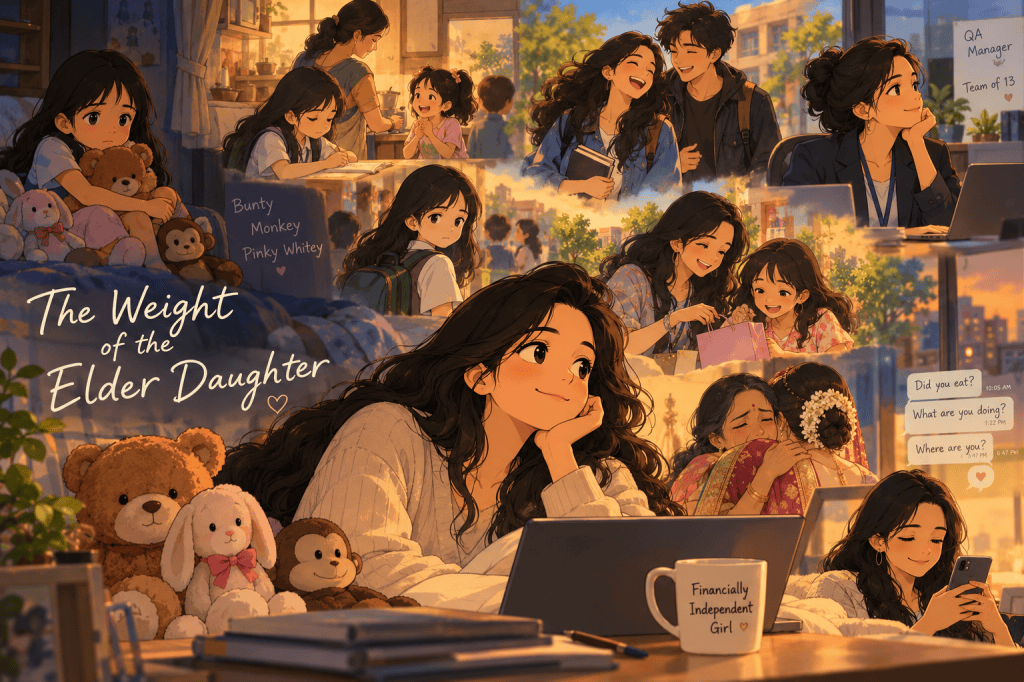
The weight of the elder daughter
I am the elder daughter.
But I was never the second mother.
I didn’t raise my younger sister. I didn’t change her diapers, supervise her homework, or feel responsible for bringing her up. In fact, I consciously refused to become that person.
I was the obedient one.
The quiet one.
The one who didn’t ask for much.
I grew up in a fairly typical middle-class South Indian family. My parents weren’t around me very much when I was growing up because they were busy making money and building a life for us.
And when my younger sister was born, things had changed a little.
My parents were more financially stable by then. My mother quit her job and stayed home with my sister.
My sister had her mother with her while growing up.
Did that automatically mean I resented my mother for it?
No.
In fact, today, I am glad my mother chose her career when she had me. I understand the circumstances differently now.
But I didn’t understand them as a child.
As a child, I simply saw my mother being there for my sister in ways she hadn’t been there for me.
And somewhere in that little mind of mine, I translated that into:
She loves my sister more.
My mother used to tell me how different my sister and I were.
My sister would come home from school and tell her everything that had happened that day. Who said what. What happened in class. What her friends did. Every little detail.
And when my mother asked me about my day, my answer was usually:
“It was okay.”
For years, I thought that was simply who I was.
The quiet child.
The one who didn’t have much to say.
But when I look back now, I wonder if it was really that I had nothing to say.
Maybe I just wasn’t comfortable enough to say it.
I didn’t share much of what I was thinking or feeling with anyone.
And strangely, I don’t even remember having many feelings as a child.
Happiness.
Sadness.
Excitement.
Anger.
None of them stand out very clearly in my memory.
What I remember are my stuffed toys.
Bunty.
Monkey.
Pinky Whitey.
I had given them ridiculous little names, and they were my tiny world.
Maybe that’s one of the reasons I still love stuffed toys and keep buying them for myself.
There is something comforting about owning a little piece of the childhood I remember.
I remember playing with my friends.
But when I think about my family, there are surprisingly few memories.
People often talk about childhood as though it is a place everyone secretly wants to return to.
I don’t.
Not because something terrible happened to me.
Nothing dramatic did.
My childhood simply felt numb in places.
And perhaps that is harder to explain.
I couldn’t wait to grow up.
There is that famous line:
“I couldn’t wait to grow up as a kid, and now I want to be a kid again.”
I can’t relate to it.
I don’t want to be a kid again.
Because being a child meant being dependent.
Dependent on my parents for money.
And because I knew money wasn’t unlimited, I rarely asked them to buy me things. They bought me what I needed, of course, but I didn’t often ask for things simply because I wanted them.
Wanting something felt like something I needed to justify.
Then I grew up.
I got into engineering.
And engineering gave me a strange sense of freedom.
For the first time, I was away from home, surrounded by people my own age, making choices for myself.
And then I fell in love.
With the only boy I ever dated.
He had a very different kind of upbringing from mine.
He did stupid things.
He got into trouble.
He wasn’t always the obedient child.
And his parents still loved him.
That was a revelation to me.
I had spent so much of my life unconsciously believing that being good was the price of being loved.
And here was this person who was essentially living proof that perhaps it wasn’t.
You could be annoying.
You could make mistakes.
You could disappoint your parents.
You could be imperfect.
And people could still love you.
So I started unlearning my good-girl habits.
Not dramatically.
One tiny habit at a time.
I got yelled at at home.
And, for once, I didn’t care quite as much.
Because I was experiencing something I hadn’t experienced much before.
Excitement.
First love has a particular kind of buzz to it.
And for the first time, I was learning that life wasn’t only about doing what was expected of me.
Then I got a job through campus placement.
And I became financially independent.
That changed everything.
Money, for me, was never just money.
It was freedom.
It meant I could buy something because I wanted it.
I didn’t have to ask.
I didn’t have to feel guilty.
I didn’t have to calculate whether I was allowed to want it.
I could simply say:
I like this.
I can afford this.
I’m buying it.
Would I ever want to go back to being financially dependent?
The thought scares me.
Because independence became such a fundamental part of who I was.
And somewhere along the way, something else happened.
I became the elder sister I never had.
Growing up, I didn’t have an older sister to ask to buy me things.
So I became that person for my younger sister.
I buy her things she asks for.
And sometimes things she doesn’t ask for.
And it gives me an absurd amount of happiness.
Maybe because I know what it feels like to want something and not ask.
Maybe because I know what it feels like to be the younger person who has no one older to spoil them.
Or maybe because somewhere inside me, the little girl who didn’t ask for much finally found a way to give.
And then came marriage.
I was in love with the only boy I had ever dated, and my parents agreed to the wedding.
In India, marriage is rarely just about two people.
Families play a huge role in marriages and weddings. There are rituals, expectations, relatives, traditions, and a whole lot of emotion attached to the process.
And traditionally, the daughter leaves her parents’ home to begin a new life with her husband and, often, his family.
On my wedding night, when I was supposed to leave my parents’ home, my mother howled.
She bawled.
She cried that her baby was leaving.
And somewhere between the tears and the chaos of that night, something in me shifted.
Until then, I don’t think I had understood the depth with which my mother loved me.
Maybe she was like me.
Maybe she simply hadn’t known how to express it.
Maybe circumstances had made both of us quieter than we actually were.
Because today, my mother texts her 35-year-old daughter three or four times a day.
Did you eat?
What are you doing?
Where are you?
And I answer her.
Every single time.
Perhaps I am making up for the 28 years of love that neither of us quite knew how to give or receive.
And maybe that’s what makes this story so strange.
There is no villain in it.
My mother wasn’t a bad mother.
My parents weren’t bad parents.
My sister didn’t take anything away from me.
Nothing terrible happened to me.
And yet, the little girl I was still experienced something.
She felt less seen.
She learned to be quiet.
She learned not to ask for too much.
She learned to become self-sufficient.
And eventually, she grew up.
She became financially independent.
She fell in love.
She got married.
She built a career.
She learned to buy herself the things she once hesitated to ask for.
She became the elder sister she never had.
And somewhere along the way, she also learned that perhaps her mother had loved her all along.
Just not always in the language she understood as a child.
Maybe this story doesn’t really have a beginning or an end.
Maybe that’s the thing about being the elder daughter.
You spend so much of your life being the person who is supposed to understand.
Understand your parents.
Understand circumstances.
Understand money.
Understand that everyone is doing their best.
And eventually, you have to turn around and understand yourself too.
The weight of being the elder daughter isn’t always that you have to carry everyone.
Sometimes, it’s that you carry your younger self for years without even realising it.
And sometimes, growing up isn’t about becoming the person your family needed you to be.
It’s about becoming the person that little girl needed.
The one who asks.
The one who speaks.
The one who wants things without apologising for wanting them.
The one who loves loudly.
The one who finally understands that being good was never the price of being loved.
And perhaps, at 35, when my mother texts me for the fourth time asking whether I’ve eaten, I am finally learning to answer her not because I have to.
But because I want to.
Maybe we are both making up for lost time.
Not because we didn’t love each other.
But because sometimes, love exists long before we learn how to express it.

